
By Naomi Fink, Chief Global Strategist and Chief Economist at Amova Asset Management
Originally published on The Post on November 12, 2026
Opinion: After the midterm elections, the Democratic Party is projected to take control of the US Congress in a dramatic shift, the biggest win since 2008. But the elections’ economic implications must be considered against a much broader macroeconomic backdrop that political change alone may do little to alter.
For most New Zealanders with a KiwiSaver account, what is going on in the US is highly relevant, even after our own election, because an important source of market exposure is not Wellington politics but Wall Street. Growth and balanced funds typically hold substantial allocations to US equities, and within those, the technology sector has been the dominant driver of returns in recent years.
The question the US midterms and New Zealand election cannot answer is whether enormous investment in AI will translate into economy-wide productivity gains that justify current valuations. That could be a greater determinant of long-term returns for KiwiSaver investors than which party controls Congress or which coalition emerges from the New Zealand election result.
Influences on market behaviour
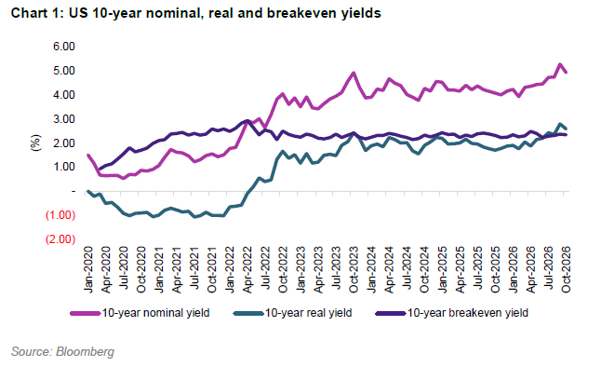
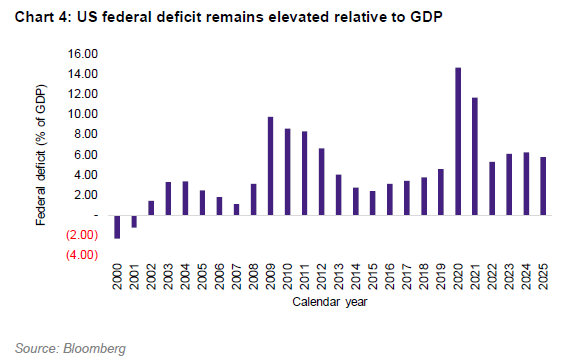
The US House of Representatives and the Senate will formally move into Democrats’ hands in January, but current market behaviour is being affected by persistent fiscal deficits of around 6% of US GDP, substantial Treasury issuance, and continued fiscal sustainability concerns irrespective of congressional control. The US 10-year Treasury yield continues to hover near 5%, reflecting elevated real yields and inflation compensation with term-premium pressures an additional concern (see Charts 1 and 2). Meanwhile, markets anticipated continued inflation pressures and restrictive Federal Reserve (Fed) policy.
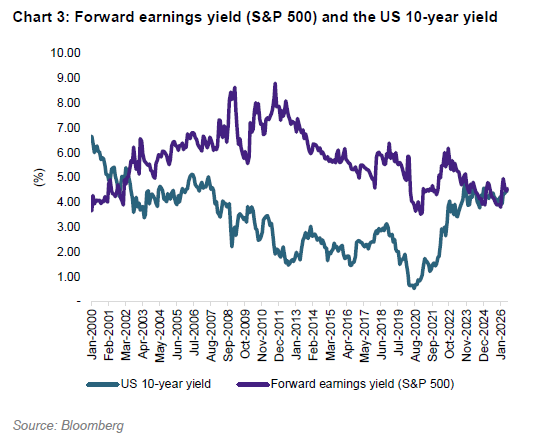
Strong AI-related earnings expectations, elevated valuations, and concentration, alongside relatively tight credit spreads and continued risk tolerance, have remained narrowly supportive of US equities, though the balance has become increasingly delicate. For weeks, equities have been showing a narrowing earnings-yield advantage relative to Treasuries, the implications being that equities may not offer sufficient remuneration to offset a trend rise in long-term yields without assuming additional risk elsewhere (e.g. credit, currency, or liquidity). At the same time, confidence over the sustainability of AI-driven capital expenditure and earnings had already begun to waver in instances where technology sector earnings results failed to live up to optimistic assumptions.
Political outcomes: direction versus magnitude
History strongly favours the opposition in US midterm elections. Between 1934 and 2022, the president’s party lost House seats in 20 of 23 midterms and Senate seats in 15 of 23. A Democratic House victory had therefore been widely anticipated by markets ahead of the result.
However, the meaningful information lies in seat changes relative to historical experience, pre-election expectations, and whether congressional control or legislative margins change. While the direction of the result was largely expected, the scale of the Democratic gains exceeded prior market expectations, and market reactions should be assessed against that benchmark. Meanwhile, the administration retains substantial executive discretion over trade, tariffs, regulation, and foreign policy, subject to applicable legal constraints. A shift in congressional power may affect new legislation more than it limits the administration’s capacity to influence economic conditions through existing executive powers.
Financial market reactions do not necessarily signal the “right answer”
In early Asian trading on 4 November, Treasury yields and the dollar declined, while US equity futures came under pressure. This would be in line with the tendency of financial markets to flatten electoral results into binary “good for X; bad for Y” outcomes. Some may argue that the results could reduce the upside risk of further fiscal expansion while increasing the risks associated with legislative deadlock and policy uncertainty. However, it is also possible to present a counter-argument. Thanks to existing government indebtedness and the vigilance of bond investors, the Administration already faced significant fiscal and market constraints on further expansion.
Still open questions: growth, productivity and earnings
The elections provide little new evidence concerning underlying productivity trends, including the realisation of AI-related improvements in productivity, particularly durable gains in total factor productivity (TFP) or the sustainability of projected earnings.
AI-related capital expenditure has already generated substantial revenues for infrastructure and technology suppliers, supporting current earnings expectations. However, these revenues largely reflect investment in productive capacity, while the broader productivity gains, and ultimately the returns needed to justify that investment, remain less firmly established.
Admittedly, greater political scrutiny of AI investment could affect the allocation and financing of capital. However, the underlying questions surrounding investment returns, the sustainability of earnings expectations, and the path from building productive capacity to new capabilities remain unresolved.
Risk distribution: possible fiscal, legislative constraints
On the one hand, the midterm results may place limits on further fiscal expansion, while potentially increasing risks associated with legislative deadlock and policy uncertainty. On the other hand, they do not materially resolve existing inflation pressures, fiscal sustainability challenges or vulnerabilities in the financing-and-confidence equilibrium.
Conclusion: elections cannot resolve the productivity question
What we have is a substantial realised expansion in productive capacity, but the question of its economic impact remains unanswered. The elections may alter the government’s capacity to formulate and implement policy, but they do not provide a satisfactory answer to the primary question at hand: whether the economy can deliver productivity growth and earnings performance already anticipated by markets. Political developments may provide a catalyst for market reassessment, but underlying vulnerabilities, and the economic adjustments required to resolve them, predate the elections. Perhaps the Fed’s 16 November field hearing of its Productivity and Jobs Task Force will provide further clues.
Naomi Fink is the Chief Economist and Chief Global Strategist for Amova Asset Management. A recognised expert on Japan’s economy, foreign exchange, and global financial markets, Ms Fink is a frequent speaker at high-profile events around the world, a commentator on TV and radio and in financial publications, and sought out for her insights by senior policymakers and officials around the world.
Disclaimer: This information is of a general nature only and does not take into account your individual objectives, financial situation or needs. It should not be relied on as financial advice. Before making any investment decision, you should seek professional advice suited to your personal circumstances. Past returns are no indication of future performance.