
By Michael De Cesare, Portfolio Manager, NZ Equities at Amova NZ
Originally published on The Post on September 14, 2026
New Zealand’s profit recovery has come through a highly testing six months largely intact. That is the constructive verdict from the August reporting season for the country’s listed companies, which covered financial results to the end of June 2026.
When companies last reported in February, the mood was openly optimistic. The economy was improving: first-quarter real GDP rose 1.5% year on year, and the December 2025 quarter was later revised higher. Profit forecasts were being lifted, and the NZX 50 was on track for a fourth consecutive quarter of gains, including a double-digit rise over the period.
Then Middle East tensions escalated. Oil prices surged and fuel costs moved sharply higher. In New Zealand, analysts debated fuel security, while offshore central banks tightened as inflation pressure returned. Market volatility rose at the same time.
The question hanging over August was simple: would the profit recovery that had taken shape in February survive the disruption?
It did. Among the companies that reported, weighted profit growth reached double digits, helped by the Utilities rebound. But the median tells a more measured story: profit growth was 9.8%, or 5.4% excluding Utilities.
Utilities did the heavy lifting
Utilities were the swing factor. Hydro lakes refilled after last year’s drought, lifting sector earnings and giving the index-level result much of its support. As the market’s third-largest sector, at roughly 17% of the NZX 50, that mattered.
That is fine in itself: a large sector returning to normal after an abnormal drought year is a legitimate part of index earnings. The problem is with Utilities leading the recovery story. The hydro rebound is, by nature, a one-off catch-up from a weak comparison, and this earnings driver cannot repeat itself in FY27.
Beyond the generators, the picture is more mixed. The global oil-price shock took its toll on certain firms, fuel costs interrupted momentum, and the consumer remains under pressure. Compared with the upbeat February reporting season, company outlook commentary is now more cautious, though still constructive: positive on the medium term, but with FY27 growth expected to arrive at a more measured, second-half-weighted pace.
A narrower recovery, but a resilient one
While not as broad-based as was taking shape in February, the profit recovery did survive, even without the Utilities boost. Compared with the peak market anxiety between March and April, the feared cascade of earnings downgrades simply did not materialise.
Geopolitical conflict, higher fuel prices, greater uncertainty and a more cautious company tone all tested the recovery. Yet earnings growth held, and the market advanced.
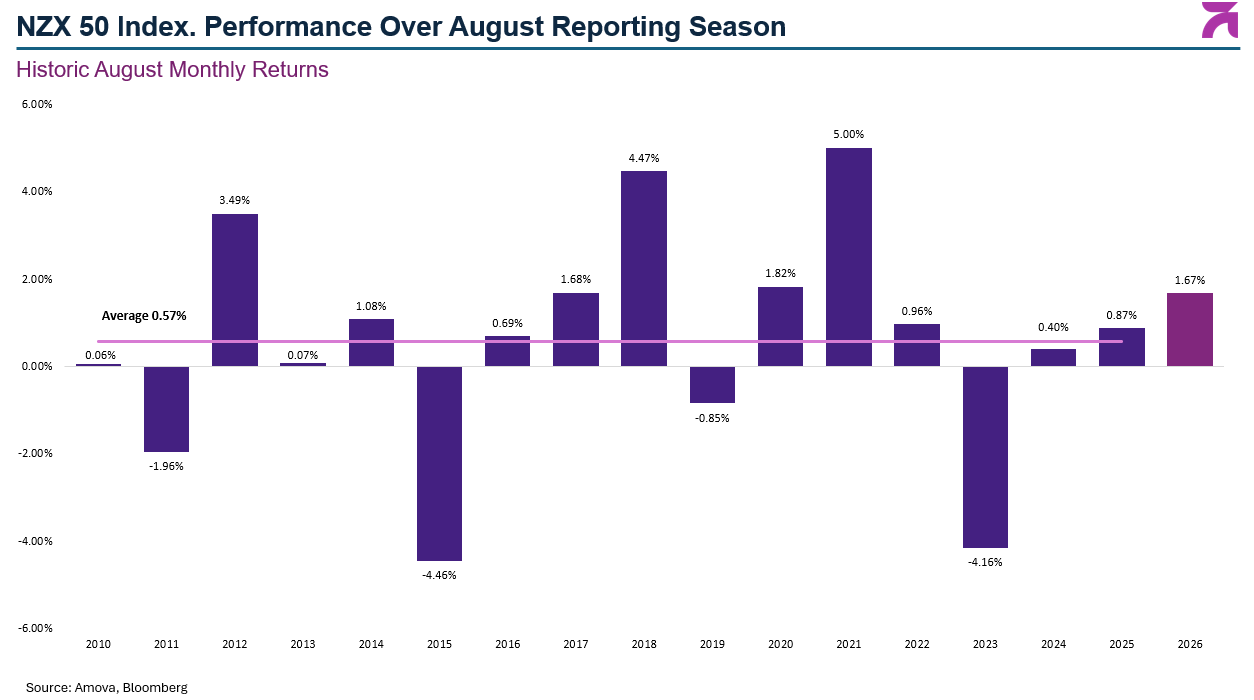
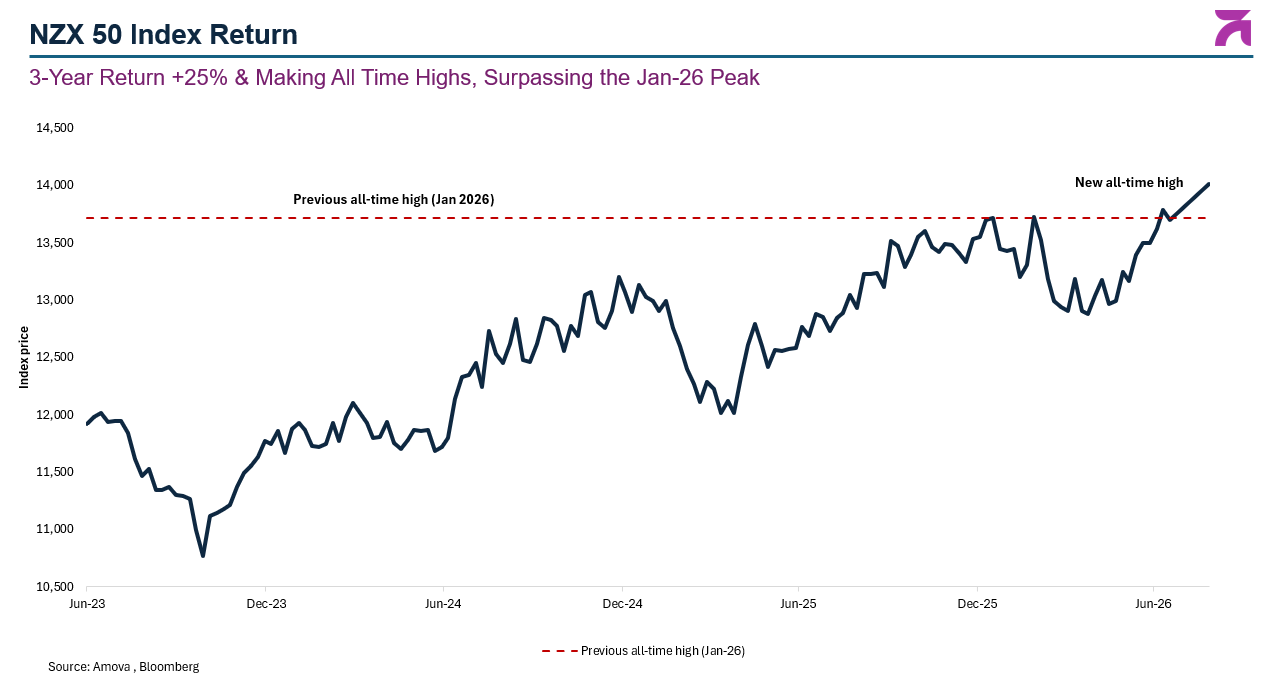
The NZX 50 ended August at record highs, with a 1.7% gain for the month - well above its average August return over the past 15 years.
From survival to breadth
For FY27, Utilities will not deliver another earnings leap and may not need to for the story to continue. A steady year of progress from Utilities, alongside a gradual firming in the rest of the market and likely stronger growth through the second half, would provide a credible platform for the index to deliver mid to potentially high single-digit earnings growth.
It would be premature to suggest this is a done deal. Several risks remain. The outlook for Middle East tensions and their local implications is difficult to predict. The RBNZ has raised interest rates twice since the August reporting period closed at the end of June 2026, and the market is pricing further tightening. A general election also adds another layer of uncertainty.
What it means for investors
For investors, company-level research remains central. In an uneven recovery, winners are likely to be determined by company-specific fundamentals and management execution, reinforcing New Zealand’s status as a stock-picker’s market.
August provided substantive evidence that the profit recovery can survive a genuine stress test. If this resilience holds, the question is no longer whether a recovery exists, but how broad it becomes and how quickly it develops.
| Company | Result date | Earnings growth |
| MEL Meridian | 26 Aug 2026 | +72.0% |
| MCY Mercury | 18 Aug 2026 | +37.6% |
| CEN Contact | 10 Aug 2026 | +36.3% |
| VGL Vista | 3 Aug 2026 | +29.3% |
| SCL Scales | 26 Aug 2026 | +17.9% |
| VSL Vulcan | 25 Aug 2026 | +16.3% |
| POT Port of Tauranga | 28 Aug 2026 | +15.9% |
| VHP Vital Health | 13 Aug 2026 | +15.5% |
| GNE Genesis | 27 Aug 2026 | +14.0% |
| THL Tourism Holdings | 25 Aug 2026 | +13.9% |
| SKL Skellerup | 20 Aug 2026 | +13.4% |
| PFI Property for Industry | 24 Aug 2026 | +13.3% |
| FRW Freightways | 17 Aug 2026 | +12.5% |
| VCT Vector | 18 Aug 2026 | +10.1% |
| NZX NZX | 20 Aug 2026 | +9.4% |
| SKT Sky TV | 28 Aug 2026 | +5.7% |
| EBO EBOS | 19 Aug 2026 | +5.0% |
| ATM a2 Milk | 18 Aug 2026 | +4.3% |
| PCT Precinct | 27 Aug 2026 | +4.2% |
| AIA Auckland Airport | 20 Aug 2026 | +3.3% |
| CNU Chorus | 24 Aug 2026 | +3.0% |
| SUM Summerset | 27 Aug 2026 | +1.9% |
| CHI Channel Infrastructure | 28 Aug 2026 | +0.8% |
| FBU Fletcher | 19 Aug 2026 | -1.9% |
| SPK Spark | 20 Aug 2026 | -2.5% |
| SKC SkyCity | 20 Aug 2026 | -22.4% |
| AIR Air NZ | 28 Aug 2026 | -47.9% |
| HGH Heartland | 20 Aug 2026 | — |
Earnings growth is on pcp - prior comparable period.
Result dates are the market-release dates (NZST). Sorted by earnings growth.
Heartland (HGH) ebitda not disclosed.
Disclaimer: This information is of a general nature only and does not take into account your individual objectives, financial situation or needs. It should not be relied on as financial advice. Before making any investment decision, you should seek professional advice suited to your personal circumstances. Past returns are no indication of future performance.